Texas Car Accident Liability & Insurance Laws
Navigating Texas auto accident injury claims requires a deep understanding of the state's specific modified comparative fault rules, minimum auto insurance limits, and liability standards. This comprehensive legal guide provides essential insights into protecting your civil rights, securing fair compensation, and successfully dealing with insurance adjusters after a devastating collision on Texas roadways.
1. The 51% Modified Comparative Fault Bar
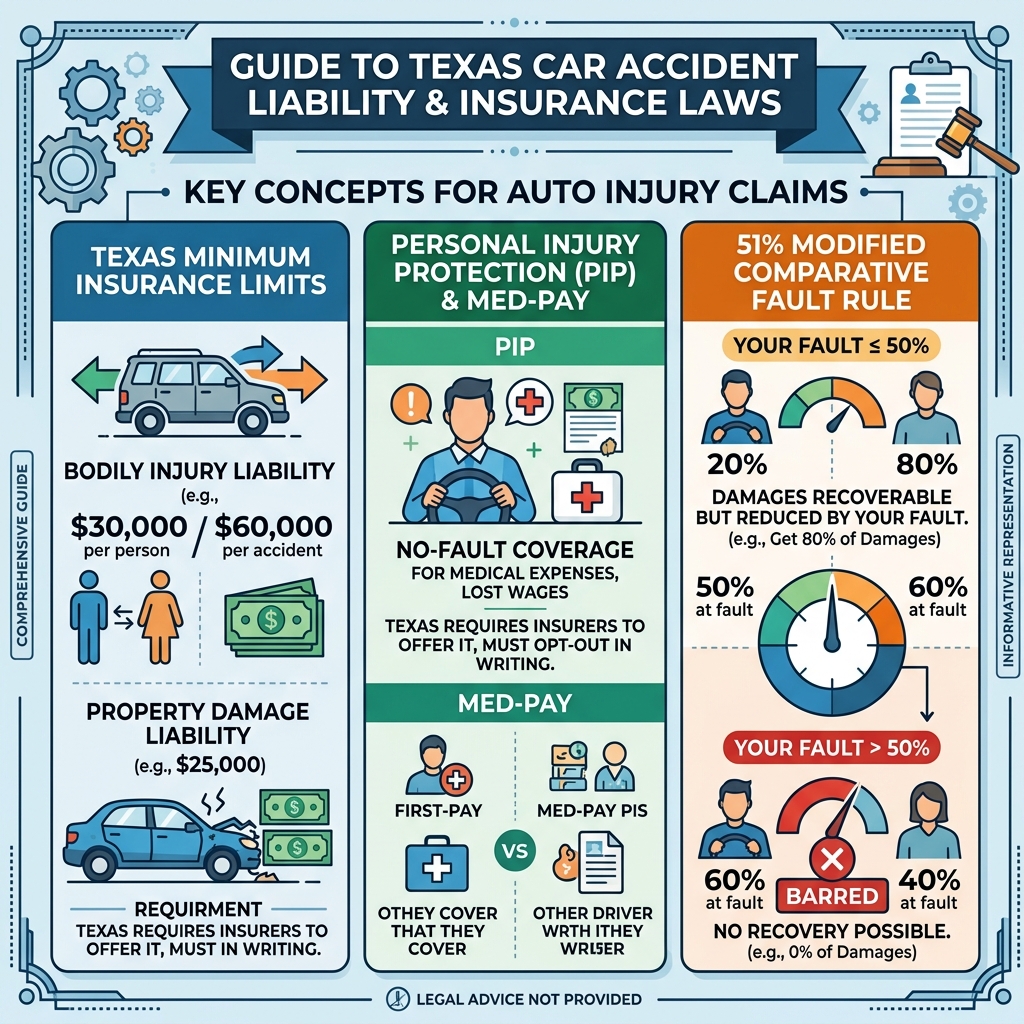
Unlike California or New York, which utilize pure comparative fault systems, Texas operates under a strict modified comparative negligence rule (often referred to as the 51% bar). In personal injury cases arising from auto accidents, commercial trucking crashes, or motorcycle collisions, you can only recover financial damages if your share of responsibility is 50% or less.
If an insurance adjuster or a trial jury determines that you are 51% or more at fault for the crash, you are legally barred from recovering any compensation whatsoever from the other involved drivers. It is an all-or-nothing threshold. Furthermore, even if you are partially at fault but under the 51% limit, your final settlement or verdict will be reduced accordingly. For example, if you are awarded $100,000 in damages but are found to be 20% at fault, your final recovery will be mathematically reduced to $80,000.
2. Texas Minimum Auto Insurance Limits
The state of Texas enforces minimum liability auto insurance requirements that are significantly higher than many other jurisdictions to better protect motorists. Texas operates under the standard 30/60/25 rule to ensure adequate financial protection for victims of negligence. All drivers must maintain insurance policies covering at least the following amounts:
- $30,000 bodily injury liability per person: The maximum payout for medical expenses and pain and suffering sustained by a single individual in a crash.
- $60,000 bodily injury liability per accident: The maximum total payout for all bodily injuries combined in a single collision, regardless of how many passengers were hurt.
- $25,000 property damage liability: Coverage strictly for vehicular repairs, total loss replacements, and structural property damage caused by the at-fault driver.
Because severe motor vehicle collisions frequently result in medical bills that easily exceed these minimums, consulting an experienced personal injury attorney is crucial. A skilled lawyer can investigate the crash to identify supplementary insurance policies, such as commercial liability coverages, umbrella policies, or your own underinsured motorist (UIM) coverage to maximize your recovery.
3. Personal Injury Protection (PIP) Rules
To provide immediate financial relief following a serious collision, Texas law dictates that auto insurance companies must automatically offer Personal Injury Protection (PIP) to all policyholders. Insurers are required by state regulations to include at least $2,500 in PIP coverage within your policy unless you explicitly reject it in a signed, written document.
PIP is highly beneficial because it operates on a "no-fault" basis. This means it covers your immediate medical bills, ambulance transportation fees, and up to 80% of your lost wages regardless of who actually caused the collision. Utilizing your own PIP coverage does not negatively impact your insurance premiums under Texas law, nor does it hinder your ability to file a formal third-party liability claim against the negligent driver's insurance company.
Frequently Asked Questions (FAQ)
What happens if I am exactly 50% at fault for a car crash in Texas?
Under the Texas modified comparative negligence system, if you are found to be exactly 50% at fault for the accident, you are still legally eligible to recover financial damages. However, your total compensation award will be reduced by your assigned 50% share of blame. You only completely lose your right to pursue a civil claim if your fault reaches the critical 51% threshold.
Is Personal Injury Protection (PIP) legally required for all Texas drivers?
Insurance providers are legally mandated to offer you PIP coverage when you purchase a liability policy. While the minimum statutory offer is $2,500, you are permitted to legally decline this coverage if you sign a formal written rejection waiver. Nevertheless, legal experts strongly recommend maintaining PIP to ensure immediate, no-questions-asked coverage for emergency medical expenses without waiting for a lengthy liability settlement to finalize.
Can I sue for damages that exceed the at-fault driver's insurance limits?
Yes. If your hospital bills, rehabilitation costs, and lost earning capacity surpass the at-fault driver's 30/60/25 minimum coverage limits, you retain the right to pursue a personal injury lawsuit against their personal assets. Additionally, your attorney may file a claim against your own Uninsured/Underinsured Motorist (UM/UIM) policy if you wisely elected to carry that supplemental protection on your vehicle.